
Chaotic Classes for the Red Valley
Created: 2026-06-08 16:05:28 | Last Modified: 2026-08-24 03:15:59
These are some custom classes for the Oldschool Essentials (B/X) D&D system, though they should be compatible with any fantasy OSR system, really. These borrow heavily from existing classes, but have been adjusted slightly to fit my own Red Valley setting and playstyle preference, specifically offering twists on the existing archetypes (Fighter, Cleric, Thief, Magic-User) for the chaotic faction.
Barbarian
- Requirements: Minimum DEX 9
- Prime requisite: CON and STR
- Hit Dice: 1d10
- Maximum level: 14
- Armour: Leather, chainmail, shields
- Weapons: Any
- Languages: Alignment, Common
- Prime requisites: A barbarian with at least 13 in one prime requisite gains a 5% bonus to experience. If both STR and CON are 16 or higher, the barbarian gets a +10% bonus. -Literacy: A 1st level barbarian cannot read or write, irrespective of INT score.
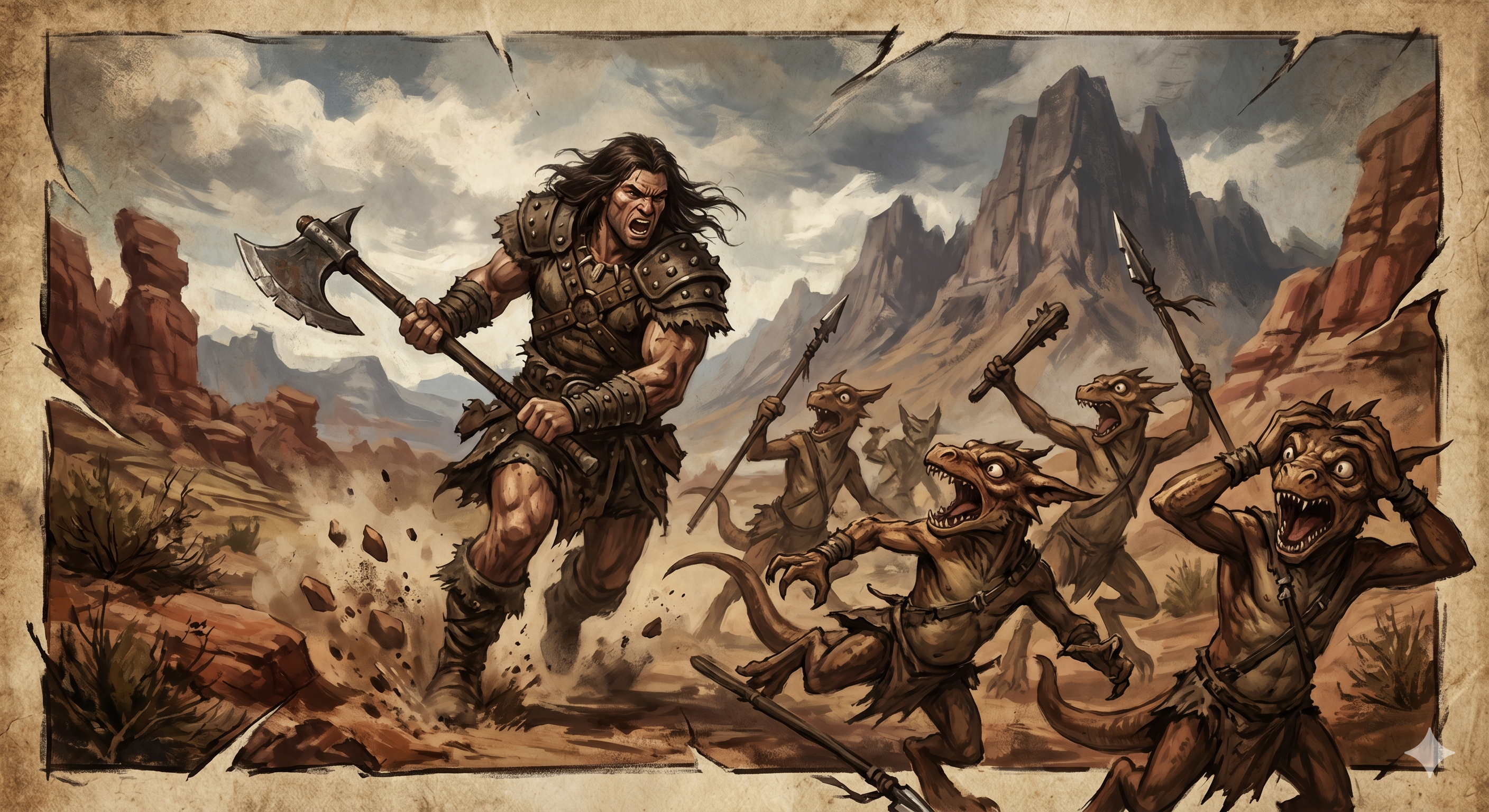
Barbarians are tribal warriors from wild lands. They are formidable fighters with many useful survival skills. They favor agility and maneuvrability over sluggish and defensive combat tactics. Fighters of the empire fear them for both their ferocious charges and tenacity in fighting.
Agile Fighting
Barbarians gain a +1 to AC when wearing no armor or leather armor. They also gain an additional +1 to AC if they receive an absolute speed boost, such as when being under the effect of a Haste spell or while wearing Boots of Speed.
Ferocious Charge
When charging, barbarians gain an additional +1 to attack and damage. This bonus increases to +2 at 6th level, and +3 at 10th level.
Rage
When a Barbarian suffers damage that puts them below or equal to half their maximum hit points (also known as the "bloodied" condition), they enter a combat rage. Upon entering a rage, the barbarian player rolls a D4 rage die once and gains the result as temporary hit points. The result of the d4 is the rage die bonus for the remained of the rage. Until the end of the combat rage the barbarian gains +1 to attack rolls and saving throws, and the rage die bonus is added to all damage rolls. It also increases the number of hit dice considered for cleave or multi-attack by its value. When the combat rage is over, the barbarian suffers from exhaustion and overexhertion and loses all temporary hit points.
A combat rage is over when either the combat encounter has concluded or the barbarian is healed to above the bloodied threshold. Being under the effects of any soothing or calming effect, such as a Charm or Calm Emotion spell, also cancels the rage. A combat rage cannot be reentered in the same combat once it has subsided for any reason. Gaining temporary hit points, whether from rage or any other source, does not count as healing and does not cancel combat rage.
At 6th level, the rage die increases to a D6. At 10th level, the rage die increases to a D8.
Barbarian Skills
In the wilderness, barbarians can use the following skills with the chance of success shown opposite:
- Climb sheer surfaces (CS): Only applies to natural surfaces (e.g. tree trunks, cliff faces). A skill roll is required for each 100’ height to be climbed. Failure indicates that the barbarian falls at the halfway point, suffering falling damage.
- Hide in undergrowth (HD): Requires the barbarian to be motionless—attacking or moving while hiding is not possible.
- Move silently (MS): A barbarian may attempt to sneak past enemies.
Combat
Barbarians can use all types of weapons and can use leather armour, chainmail, and shields.
The barbarians base attack bonus is equal to their level.
Cure Poison
In the wilderness, a barbarian can gather herbs to concoct an antidote to natural poisons. This takes one turn per character to be cured. Each subject may make a second save versus poison to end the effects.
Foraging and Hunting
A party with a barbarian succeeds at foraging with a 2-in-6 chance and finds prey when hunting with a 5-in-6 chance (see Wilderness Adventuring, p224).
Horde Caller
Upon reaching 8th level, the barbarian’s reputation is enough to call upon their native people to form a temporary, devastating war horde. Mustering the horde takes one week of preparation. The horde consists of 1d4 * 50 tribal warriors (1st level fighters with basic combat gear, potentially mounted if customary to their culture).
A horde can only be called for a specific, immediate purpose (e.g., raiding an imperial outpost, rescuing hostages, or defending a tribal holy site). Once this objective is achieved, abandoned, or after one month has passed, the horde disbands to return to their lands. For every level achieved above 8th, the barbarian may automatically add a flat +50 warriors to the horde's maximum size.
Barbarian Level Progression
| Level | XP Required | Hit Dice (HD) | THAC0 | Death | Wands | Paralysis | Breath | Spells |
|---|---|---|---|---|---|---|---|---|
| 1 | 0 | 1d10 | 19 [0] | 10 | 13 | 12 | 15 | 16 |
| 2 | 2,200 | 2d10 | 19 [0] | 9 | 12 | 11 | 14 | 15 |
| 3 | 4,400 | 3d10 | 19 [0] | 9 | 12 | 11 | 14 | 15 |
| 4 | 8,800 | 4d10 | 17 [+2] | 8 | 11 | 10 | 13 | 14 |
| 5 | 16,500 | 5d10 | 17 [+2] | 8 | 11 | 10 | 13 | 14 |
| 6 | 33,000 | 6d10 | 17 [+2] | 7 | 10 | 9 | 12 | 13 |
| 7 | 75,000 | 7d10 | 14 [+5] | 7 | 10 | 9 | 12 | 13 |
| 8 | 130,000 | 8d10 | 14 [+5] | 6 | 9 | 8 | 11 | 12 |
| 9 | 250,000 | 9d10 * | 14 [+5] | 6 | 9 | 8 | 11 | 12 |
| 10 | 380,000 | 9d10 + 3 * | 12 [+7] | 5 | 8 | 7 | 10 | 11 |
| 11 | 510,000 | 9d10 + 6 * | 12 [+7] | 5 | 8 | 7 | 10 | 11 |
| 12 | 640,000 | 9d10 + 9 * | 12 [+7] | 4 | 7 | 6 | 9 | 10 |
| 13 | 770,000 | 9d10 + 12 * | 10 [+9] | 4 | 7 | 6 | 9 | 10 |
| 14 | 90,0000 | 9d10 + 15 * | 10 [+9] | 3 | 6 | 5 | 8 | 9 |
- *: Con bonus no longer applies to hit points.
Barbarian Skills
Each skill has between 1 and 5 pips. To test a skill, roll 1d6. If the die comes up lower or equal to your number of pips in that skill, the test is successful. Barbarians start with the following skill pips.
| Skill | Starting Pips |
|---|---|
| Climb sheer surfaces | 3 |
| Hide in undergrowth (HD) | 1 |
| Move silently (MS) | 1 |
On every even level, the Barbarian gains 1 skill pip that they may use to increase any of the above skills. A skill can be increased up to a maximum of 5 pips.
Player Knowledge
The referee should roll for hiding and moving silently on the player’s behalf, as the barbarian always believes the attempt to be successful. If the roll fails, the referee knows that the barbarian has been noticed and should determine enemies’ actions appropriately.
Witch Doctor
- Requirements: None
- Prime requisite: INT
- Hit Dice: 1d4
- Maximum level: 14
- Armour: Leather
- Weapons: Staff, Blowgun
- Languages: Alignment, Common
- Prime requisites: A witch doctor with at least 13 in INT gains a 5% bonus to experience. If they have a INT of 16 or greater, the experience bonus is 10% instead. -Literacy: A first level healer can read and write if they have an INT of at least 9.
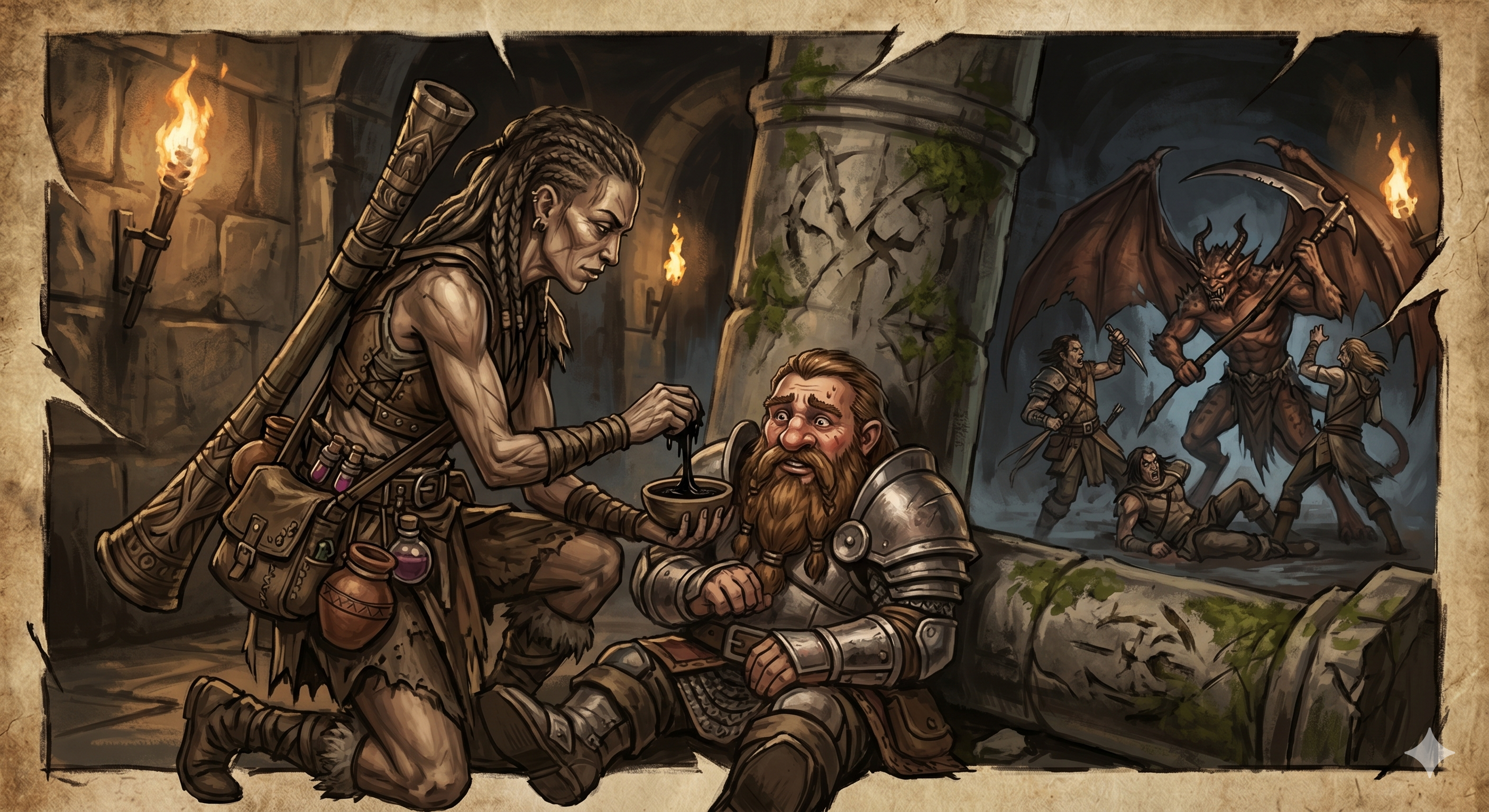
The witch doctor class encompasses specialists who treat the mortal body not through divine grace, but as a volatile chemical crucible. Witch doctors are figures of eerie necessity-frequently disgusting, smelling of swamp rot, and generally unsettling to be around, yet utterly indispensable. They do not cast clean spells; instead, they rely on crude tools, regional herbs, and the agonizing speed of primitive battlefield medicine to stitch wounds and filter lethal venoms through their own organs. A chaotic party members' relationship with their witch doctor is a simple trade-off: you survive the dungeon's horrors by enduring the visceral horrors of their care. At the very least, they can blind your enemies with a blowgun.
Witch Doctor Skills
Witch Doctors have the following skills, which each have 1 to 5 pips in them. To test a skill, roll 1d6. If it comes up below or equal to the number of pips, the skill was applied successfully.
- First-Aid: Instantly restore 1d6+1 hit points to a character that has been wounded and is at least bloodied (at or below half max HP). First aid takes 1 combat round and requires the recipient to not move and spend their action on receiving first aid. It also consumes one healing kit charge. Characters can only benefit from first-aid once, until they lose the bloodied condition. With 5 pips in this skill, restores 2d6+2 hit points instead.
- Surgery: Assist long-term recovery. Restore 1d6+1 hit points for every odd level of the witch doctor in a character that is resting during downtime. Also cuts wound recovery times in half. Consumes 1 healing kit charge. A witch doctor can attempt to provide surgery to a number of characters per day equal to half the witch doctor's level and can do so only once per day.
- Poison Lore: Slow deadly poisons and neutralize damaging ones through a mix of herbal antivenoms and wound treatment. A character that is poisoned and will die in a number of turns will die in an equal number of days after a successful treatment, while non-lethal poisons are completely removed. Consumes an entire healing kit (3 charges). Treatment takes 1 turn, though it's effect on lethal poison is immediate. Can also be used to create a poison dart (takes 1 healing kit charge).
- Bloodletting: Deals 1 point of damage and heals a disease in a patient. Can only be attempted once a week, as the patient needs to recover from the bloodloss. Regardless of whether bloodletting fails or succeeds, the patient is left exhausted, and has a -1 to attack rolls and saving throws for 1d4 days.
- Entheogenics: Cure negative mental effects, such as confusion, charm, and fear during downtime rest by inducing a psychedelic experience in a subject for 1 healing kit charge. Success always increases morale by +1 for 1d4 days. Can be used for communion with your own unconscious to recover lost memories or seek hidden knowledge for 3 charges of the healing kit. Communion may only be done once a month.
- Biodistillation: Transform a poisonous substance into something non-poisonous and potentially useful. The poison source must be fresh, such as from a monsters venom gland, a toad's skin, ora freshly picked poison mushroom. Special pools of toxic swamp water, such as a mercury infused pond may also work. Store bought poisons are stale and unsuitable for biodistillation. On success generates a random biodistillation potion and restores 1d6+1 hit points to the witch doctor. On failure, generates a potion of water. The new potion appears after 1d4 turns (in exactly the way you think). Ingesting poison for biodistillation is safe for the witch doctor, though they are still vulnerable to monster venom and high doses of poison. With 5 pips in this skill, the witch doctor becomes completely immune to poison.
Witch Doctors gain 1 pip for every level after 1st, which they may use to increase any of their skills by 1, up to a maximum of 5 pips in any individual skill.
Medical Equipment
Witch Doctors are always prepared to offer medical assistance and so walk around with various flasks, satchels, powder bags and vials slung around their body and attached to their belt. They gain an additional +2 quickslots, which can be used exclusively for the purpose of carrying potions, as well as healing kits.
Witch Doctor's carry healing kits with them which contain the various ingredients used for their craft, and which are used in many of their skills.
- 1 Kit has 3 charges and takes 1 inventory slot.
- Apart from its use in healers skills, charges have applications depending on the biome the healer's kit was assembled in (see table below).
- Witch Doctor's can spend time to gather herbs and ingredients, which takes 8 hours and yields 1 healer's kit. Alternatively they can purchase the necessary herbs for 10 GP per kit on a local market. Under normal circumstances, ingredients for 1d4 kits can be found on any given day on an average size market. However ingredients are rare, and it usually takes a month for an area (3 mile radius or 6 mile hex) to regrow the necessary ingredients for a healing kit. Markets replenish on the same monthly timeframe, except in very large, busy cities, where it may only take a week.
- Kits contain herbs, salves, pultices, and a special paste, called "salvora", that the healer makes by chewing up roots and leaves. Salvora reacts violently and quickly thickens when it comes into contact with blood. Witch Doctors use this effect to quickly seal wounds and apply first-aid. Witch Doctors know how to make salvora from various herbs and can adapt this to different biomes.
- Healer's kits are always specific to the biome that the ingredients used to make them were gathered in. There are "Desert healer's Kits", "forest healer's Kits", etc, but all healer's kits contain salvora, and they can all be used for the D6 healer's skills.
Combat
Witch Doctors may wear leather armor or cloth robes. They cannot use shields. They may only use staves or a blowgun, and usually only do so in self defense.
Witch Doctors have a base attack bonus equal to 2/3 of their level.
Blowgun
- Size: Two-Handed. Blowguns are massive, 6 to 8 feet long wooden tubes.
- Optimal Range: 10 ft to 20 ft (+1 to-hit)
- Normal Range: 20 ft to 40 ft
- Long Range: 40 ft to 60 ft (-1 to-hit)
- Damage: 1d2
- Ammunition: Blowgun Dart, stacks of 5 per slot Can be infused with potions.
The blowgun is a special weapon normally only used by witch doctors. They are 6 to 8 feet long, massive hollowed out tubes of wood, bone or bamboo that are used to propel special darts using one's breath.
Every witch doctor comes with their own blowgun. With access to wood a witch doctor can fashion a new blowgun in about 3 days of downtime. Similarly a witch doctor can create a stack of 5 blowgun darts in 8 hours of work using wood, bamboo, animal bones, bird feathers and cloth as materials. In a pinch they can also fashion these from regular arrows or bolts. Blowgun darts can never be substituted for by regular darts or arrows, as they require a special seal at their base that is meticulously trimmed to exactly close with the blowgun's inner diameter to maximize air pressure and acceleration.
Blowguns are most often used not for their damage but for the effect of their darts. Witch Doctors can infuse darts (in stacks of 5) with potions, consuming the potion in the process. Successfully hitting a target (friend or foe) will apply the potion's effect to the target. Effects applied in this way last only 1/5 as long as when the entire potion is consumed.
Witch doctors can create poison darts either from regular potions of poison that are bought or found (stacks of 5), or via their poison lore skill and a healing kit charge (1 individual dart).
- Poison Dart: On a hit, target must save vs. death or die in 1d4 turns. Targets with 2 HD or less are slain instantly on a failed save. Creatures with 8 HD or more take 6D6 damage after 1d4 turns instead. Undead and creatures with poison resistance are not affected.
Witch Doctor Level Progression
| Level | XP Required | Hit Dice (HD) | THAC0 | Death | Wands | Paralysis | Breath | Spells |
|---|---|---|---|---|---|---|---|---|
| 1 | 0 | 1d4 | 19 [0] | 11 | 14 | 13 | 14 | 15 |
| 2 | 1,200 | 2d4 | 18 [+1] | 10 | 13 | 12 | 13 | 14 |
| 3 | 2,400 | 3d4 | 17 [+2] | 10 | 13 | 12 | 13 | 14 |
| 4 | 4,800 | 4d4 | 17 [+2] | 9 | 12 | 11 | 12 | 13 |
| 5 | 9,600 | 5d4 | 16 [+3] | 9 | 12 | 11 | 12 | 13 |
| 6 | 20,000 | 6d4 | 15 [+4] | 8 | 11 | 10 | 11 | 12 |
| 7 | 40,000 | 7d4 | 15 [+4] | 8 | 11 | 10 | 11 | 12 |
| 8 | 80,000 | 8d4 | 14 [+5] | 7 | 10 | 9 | 10 | 11 |
| 9 | 160,000 | 9d4 * | 13 [+6] | 7 | 10 | 9 | 10 | 11 |
| 10 | 280,000 | 9d4 + 1 * | 13 [+6] | 6 | 9 | 8 | 9 | 10 |
| 11 | 400,000 | 9d4 + 2 * | 12 [+7] | 6 | 9 | 8 | 9 | 10 |
| 12 | 520,000 | 9d4 + 3 * | 11 [+8] | 5 | 8 | 7 | 8 | 9 |
| 13 | 640,000 | 9d4 + 4 * | 11 [+8] | 5 | 8 | 7 | 8 | 9 |
| 14 | 760,000 | 9d4 + 5 * | 10 [+9] | 4 | 7 | 6 | 7 | 8 |
- *: CON bonus no longer applies.
Starting Skill Pips
At 1st level, witch doctors have the following distribution of pips in their skills.
| Skill | Pips |
|---|---|
| First-aid (FA): | 2 |
| Surgery (S) | 1 |
| Poison Lore (PL) | 1 |
| Bloodletting (BL) | 1 |
| Entheogenics | 1 |
| Biodistillation | 1 |
- Scramble: As an optional rule, if player and referee agree, the healer skills may be randomized. To do this, take the above pip array and select one skill randomly to remove 1 piip from. Then select a skill randomly again and increase it by 1.
Biodistillation Potions
When a witch doctor successfully uses biodistillation, roll 1D20 and consult the table below for the resulting potion.
| 1D20 | Potion |
|---|---|
| 1 | Potion of speaking with Fish |
| 2 - 5 | Potion of Healing |
| 6 - 7 | Antivenom |
| 8 | Potion of Poison Resistance |
| 9 | Potion of Magic Resistance |
| 10 | Potion of Clairvoyance |
| 11 | Potion of Clairaudience |
| 12 | Potion of Calm Emotions |
| 13 | Potion of Confusion* |
| 14 | Potion of Fear* |
| 15 | Potion of Sleep* |
| 16 | Potion of Paralysis* |
| 17 | Potion of Dim Light Vision |
| 18 | Potion of Mind Shielding |
| 19 | Potion of Speed |
| 20 | Potion of Heroism |
- *: Can be thrown and results in a 10 ft splash radius with effects similar to the corresponding spell (you are literally throwing piss bottles at monsters here, time to celebrate).
Healing Kit Stats and Biomes
Here are the various effects of 1 charge of a healing kit that was bought or collected in the given Biome, along with the most common or most prevalent ingredient that is characteristic to each biome.
| Biome | Ingredient Name |Effect (1 charge) | |---|----| | Temperate Forest (Coniferous) | Tumormoss | Accelerate wound healing by 33%. High bitterness threshold. | Temperate Forest (Pine) | Penicilin Fungus | Found on the bark of some pine trees. Can cure bacterial infections. Highly sought after, healing kits based on this go for double the price. | | Plains | Extract of phalaris Grass | Low-impact psychedelic; -1 to saves vs. mind affecting spells. | | Hills | Dried mossdwarf mushroom | Lowers blood pressure. | | Mountain | Mountaindwarf Mushroom | Raises blood pressure (easy to mistake for mossdwarf mushroom). | | Coast | Veil of St. Kathrin Algae | Minty flavor. Grants +1 intelligence if consumed every day and your normal intelligence is below 8. | | River | Horse Radish Tuber | Ethereal oils have intense, tangy aroma. Can be used to induce consciousness in the unconscious, sleeping, or comatose and is often made into smelling salts. | | Tropical Jungle | Ayahuasca Vine | Anti-depressant properties. Often consumed in volume in a "brew". Combine with phalaris for a free cast of communion. | | Snowy Tundra | Glissfoil | Minty taste. Topical application tends to cure any skin ailment. Annihilates sunburns. | | Desert | Boiled juice of the mescaline cactus | Hear noise increased by 1. "Only way to fly." | | Underground | Cragslime Globules | Texture described as "particularly revolting". Parasympathetic depressant, slows digestion and breathing. Sometimes used as cough medicine. Highly addictive. | | Badlands | Burnbush Berry | Spicy flavor. 1 charge grants fire resistance for 1 round, 3 charges grant fire resistance for 1 turn. | | Swamp | Iron Lotus Petals | Moderate Non-steroidal anti inflammatory. Used to assist recovery and still a fever. Coveted, doubling price of healing kit.|
Loser
- Requirements: Sum of all attribute modifiers must be negative.
- Prime requisite: CHA
- Hit Dice: 1d6
- Maximum level: 14
- Armour: Any, except shields.
- Weapons: Any
- Languages: Alignment, Common
- Prime requisites: A loser with at least 13 in CHA gains a 5% bonus to experience. If CHa is 16 or higher, the bonus is 10% instead. -Literacy: A first level loser can read and write if their INT is 5 or higher.
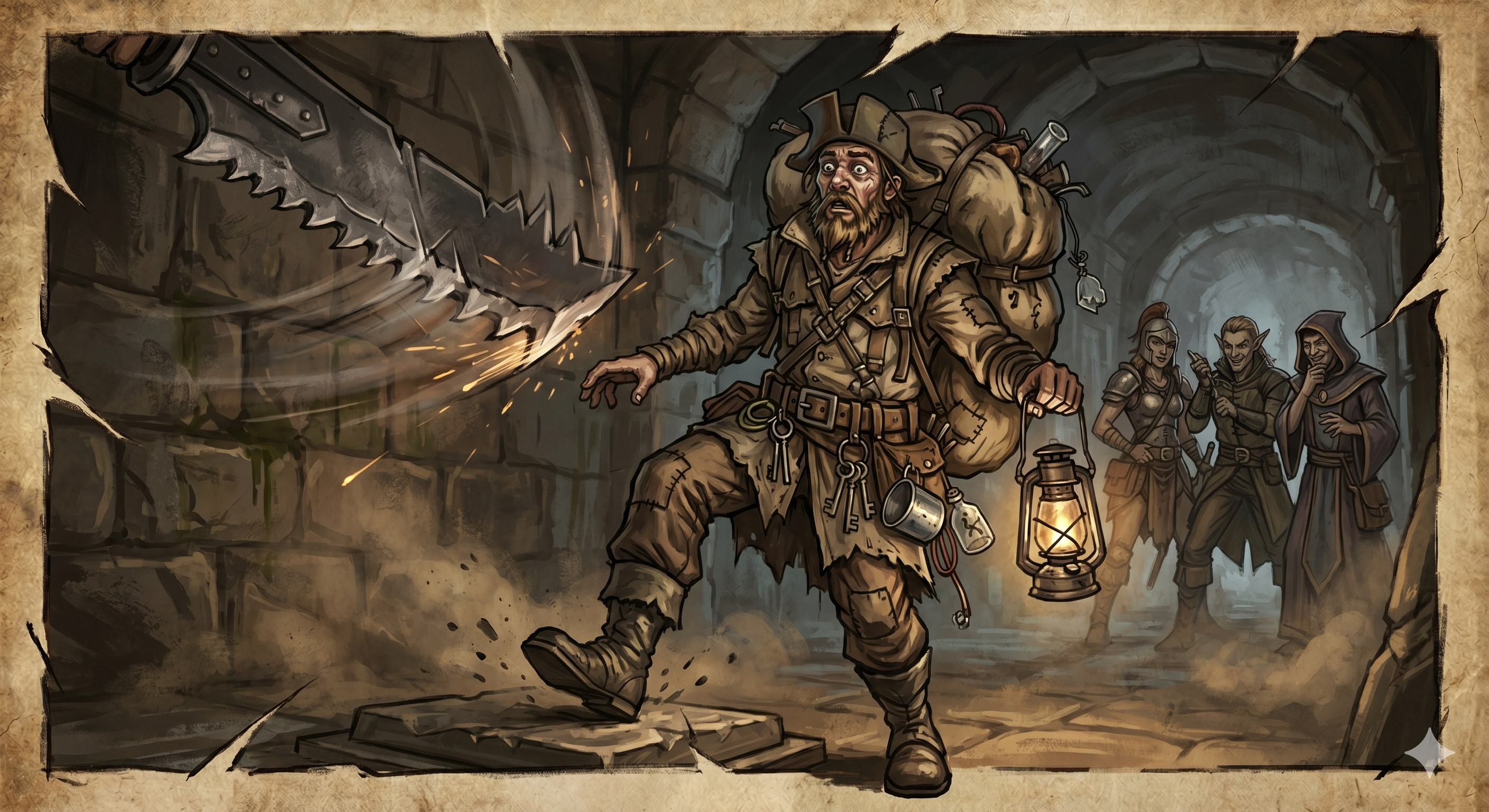
The loser class encompasses characters that not only lack heroic qualities, but have been designated by nature or fate to be well below the civilian average of skill and aptitude, yet still seek a life of adventure. Losers are often dull, clumsy, vexing, lazy, and ineffective. The loser's negative and disagreeable qualities are, however, never pronounced to the point of anti-heroism or villainy, as this would make them interesting, which the loser is generally not. Losers, by definition, are on the lower end of natural ability or social status, and most chaotic cultures believe that the gods, karmic forces, or the universe conspire to even the score for losers. This is why it is seen a "generally a good idea" to have a loser in your group, as their luck might rub off on you. A groups loser, while frequently being the object of derision and scorn, contributes to the communities well being and success in hidden and sometimes even mysterious ways. At the very least they can carry your stuff.
Beast of Burden
Losers can carry twice the normal number of inventory slots (so2x their strength score), and they have 5 quickslots instead of 3, which they can use for anything.
Scavenger
In any city, town, large farm, or similar settlement, the loser can spend 4 hours scavenging and is able to find exactly 1 version of any mundane item whose value does not exceed 5 GP.
Items that typically come in stacks (such as a bundle of torches) will be found as a bundle by the loser. If the price of a bundle exceeds 5 GP the loser may find a single version of the item that does not exceed the cost limit.
Scavenging in the same place more than 3 times a month usually results in conflict with the law, local crime lords, or whoever else is in charge.
The referee can veto the scavenging success for certain items if specific fictional conditions are given that are central to the adventure. For example, a loser may be unable to find an iron crowbar if an iron shortage is a central point of the adventure.
Trap Affinity
Losers have a tendency to trigger traps, which makes them somewhat resilient to their effects.
Whenever a loser fails a saving throw from a trap that they triggered, an item in their quickslots is destroyed by the trap, and they succeed on the save instead. Due to the initial failure, their luck die is stil upgraded.
The item to be destroyed is determined in the following way: Roll 1D6 for the item in the 1st slot. If it comes up below 4, the item in slot 1 is destroyed. If it comes up 4 or higher, move on to the 2nd slot and roll 1D6 again, and so on, until either an item is destroyed on a 1 through 3, or you have exhausted all slots with items in them. In the latter case, the loser still fails the saving throw.
Loser players are encouraged to organize their quick slots from most expendable item to least expendable. Fictionally, this means that the loser is wearing the item that occupies the first quickslot in an exposed, prominent way, where it is most likely to block a hit. It is perhaps not uncommon that their party members point out to them that this is unwise e.g. "hey loser that potion will break if you carry it around your neck like that." It is perhaps also not uncommon for the loser to ignore their advice.
Critical Hit Affinity
Losers have a tendency to get hit quite badly. This has also made them somewhat resilient, however.
When a loser gets hit by a critical hit (20 on a D20, regardless of whether you play with crits or not), they may block the hit with one of their quick slot items, negating any damage and effects entirely, and destroying the item.
This follows the same rules as trap affinity, i.e. roll 1D6 for each slot starting with the first. If the loser is out of items or rolls high on all of them they still take the full critical hit. Negating a critical via a destroyed item still triggers a luck die upgrade.
Luck
Loser's luck tends to rub off on other members of the party. This is mechanically represented by a luck die. The luck die can be bestowed upon others for benefits, and can be upgraded and downgraded, which moves it along a dice chain. Initially, this is a D2, and it resets to D2 at the morning of every adventuring day.
Upgrades
The luck die upgrades when any of the following events procur:
- The loser rolls a critical miss on an attack roll.
- The loser gets hit by a critical hit.
- The loser fails a saving throw.
- The loser fails a skill check.
Downgrades
The luck die downgrades after the loser bestows their luck upon other party members.
Bestowing Luck
Whenever a character in the loser's presence fails an attack roll or saving throw, the loser may bestow their luck upon them, provided the player can describe how the loser, perhaps unwittingly, influences the situation to the other player's benefit.
If luck is bestowed in this way the receiving player may roll the loser's luck die and add its result to their failed roll, possibly turning a failure into a success. The luck die is subsequently downgraded.
Losers cannot bestow luck upon themselves.
Dice Chain
Below is an ordered sequence of dice. We call this the dice chain.
- D0
- D2
- D3
- D4
- D5
- D6
- D7
- D8
When the luck die is upgraded, it is replaced by the die in the chain with the next higher number of sides. When the luck die is downgraded, it is replaced with the die with the next lower number of sides. For example, a D4 upgrades to a D5 and a 3 downgrades to a D2.
Downgrading a D0 has no effect, it is the lowerst possible die in the chain. Upgrading a D8 has no effect. It is the highest possible die in the chain.
The D0 step in the chain essentially represents the loser being out-of-luck, and renders them unable to bestow any luck (at least it can't get any worse).
D3, D5, and D7 are often called odd dice or "Zocci" dice. They can be hard to get. If you don't have any, simply simulate them with a die that has a number of sides one greater than the odd dice you wish to roll, and reroll on a maximum result. A D2 can be simulated with a coin or by rolling a D6 with 1 through 3 resulting in 1, and 4 through 6 resulting in 2.
Loser-Type
At 5th level the loser discovers more about who they are and comes to accept their destiny as a mediocre, supporting role in the lives of real heroes. Choose one of the following loser subtypes to customize your loser:
| Loser Type | Effect | Typical Quote |
|---|---|---|
| Champion of Mediocrity | Minimum die in the dice chain becomes D1. | "I'm happy with what I've got." |
| Cat Lady | You can scavenge small animals, which can inhabit your quickslots. Your improvised weapon bonus is doubled. | "AAaarrrrgggghhhhh!" |
| Lazy Stayabout | Loser becomes fat, but only a little. Instead of resetting to a D2, your luck die resets to a D4 each morning. | "I could stop anytime I want. I just don't want to." |
| Procrastinator | The dice chain is extended to a D10 in the maximum slot, but you reset each morning to a D0. | Note to self. Add quote here next week. |
Adventuring Business
At 8th level, the loser may start a business that is appropriate for former adventurers, such as a magic item shop, tavern, adventuring supply store, or similar. Acquiring this business and opening it requires no gold or resources from the loser, it is something that is arranged in the background, either through connections, favors, or dumb luck and serendipity. The business thus acquired is usually not a high quality asset.
The business is completely unprofitable (it is run by a loser, after all), but it attracts experienced adventurers. Every month, the loser may recruit 1d4 adventurers with a level equal to half the level of the loser. Normal rules and leadership limits for hirelings apply.
Combat
Losers can use any weapon, but generally don't lok cool while doing so.
Losers can wear any armor, but armor often ends up ill-fitting and in poor quality while on the loser. This is especially pronounced for plate mail, which never looks splendid or heroic on a loser. This effect is so pronounced that any character beholding a loser in plate is revolted by the incongrous image, and the loser has a -1 to any reaction roll while wearing plate.
Losers may not use shields.
Losers are often unable to afford real equipment, and so are accustomed to wield something from their vast array of scavenged garbage into combat. They gain a +1 bonus to attack rolls with improvised weapons. This bonus increases to +2 at 6th level, +3 at 9th level, and +4 at 12th level.
Losers have a base attack bonus of 2/3 their level.
Loser Level Progression
| Level | XP Required | Hit Dice (HD) | THAC0 | Death | Wands | Paralysis | Breath | Spells |
|---|---|---|---|---|---|---|---|---|
| 1 | 0 | 1d6 | 19 [0] | 13 | 14 | 13 | 16 | 15 |
| 2 | 1,000 | 2d6 | 18 [+1] | 12 | 13 | 12 | 15 | 14 |
| 3 | 2,000 | 3d6 | 17 [+2] | 12 | 13 | 12 | 15 | 14 |
| 4 | 4,000 | 4d6 | 17 [+2] | 11 | 12 | 11 | 14 | 13 |
| 5 | 8,000 | 5d6 | 16 [+3] | 11 | 12 | 11 | 14 | 13 |
| 6 | 16,000 | 6d6 | 15 [+4] | 10 | 11 | 10 | 13 | 12 |
| 7 | 32,000 | 7d6 | 15 [+4] | 10 | 11 | 10 | 13 | 12 |
| 8 | 65,000 | 8d6 | 14 [+5] | 9 | 10 | 9 | 12 | 11 |
| 9 | 130,000 | 9d6 * | 13 [+6] | 9 | 10 | 9 | 12 | 11 |
| 10 | 230,000 | 9d6 + 1 * | 13 [+6] | 8 | 9 | 8 | 11 | 10 |
| 11 | 330,000 | 9d6 + 2 * | 12 [+7] | 8 | 9 | 8 | 11 | 10 |
| 12 | 430,000 | 9d6 + 3 * | 11 [+8] | 7 | 8 | 7 | 10 | 9 |
| 13 | 530,000 | 9d6 + 4 * | 11 [+8] | 7 | 8 | 7 | 10 | 9 |
| 14 | 630,000 | 9d6 + 5 * | 10 [+9] | 6 | 7 | 6 | 9 | 8 |
- *: CON bonus no longer applies.
Sorceror
- Requirements: Minimum CHA 9
- Prime requisite: CON
- Hit Dice: 1d4
- Maximum level: 14
- Armour: None
- Weapons: Daggers, staves, slings and throwing darts
- Languages: Alignment, Common
- Prime requisites: A sorceror with at least 13 in CON gains a 5% bonus to experience. If they have a CON of 16 or greater, the experience bonus is 10% instead. -Literacy: A first level sorceror can read and write if they have an INT of at least 8.
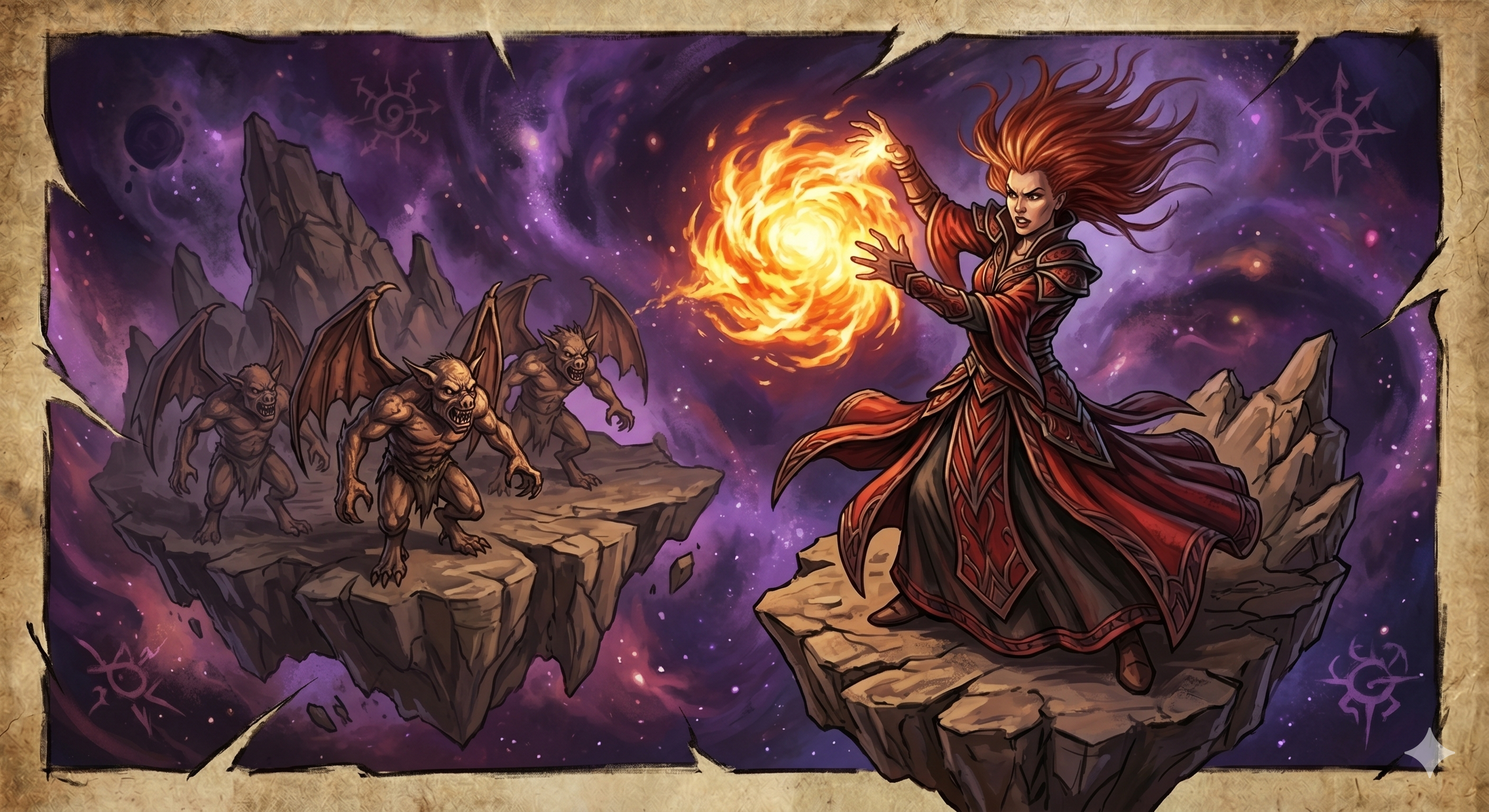
Sorcerors are gifted by blood or fate with an innate and intuitive access to magic. Spellcasting to a sorceror is not a deliberate and studied choreography, but a creative expression and manifestation of their will. It comes from the belly, not the head. Sorcerous magic is unique, nonrepeatable and deeply personal. While many sorceror's lack the precision of the spellbook-carrying variety of magic-users, they make up for this with the raw power of their magic. Most sorcerors work alone, and many are entirely self-taught. They see the teacher-student dynamic that is prevalent among wizards as an oppressive constraint on their freedom and creativity. Most sorceror's can trace their innate powers to some kind of magical heritage, such as a dragon, cyclops, unicorn or even demigod somewhere up in their family tree. Others possess powers whose origin is entirely mysterious even to them.
Spellcasting
Sorcerors cast spells similarly to magic-users, except that they do not memorize spells and do not have a list of spells to choose from. Instead, the sorceror's player describes the magical effect he or she wishes to create and then tests his or her skill in the one of their magic school skills. Stronger effects require greater skill and power invested by the sorceror. Sorcerors are not limited in the number of spells they can cast each day, but the tax of drawing on their magical power always has a chance to harm them.
Magic School Skills
The sorceror's innate knowledge of magic is represented mechanically by magical skill in the 8 schools of magic. We measure this skill with 'pips', which can range from 1 to 3 initially. Spells are cast by successfully testing against these skills. The 8 schools are:
- Abjuration: Protecting, warding, and dispelling of harmful effects.
- Conjuration: Binding and bringing into being of entities. Teleportation. Create solid walls.
- Divination: Acquiring knowledge through supramundane means and preventing others from doing it to you.
- Enchantment: Charm, dominate, suggest, influence, and curse others.
- Evocation: "Blow shit up.". Create elemental walls.
- Illusion: Manipulate other's perception into a false model of reality.
- Necromancy: Wield the energies of life and death. Summon or control the undead. Also includes healing.
- Transmutation: Alter beings, slow down or speed up, scatter or gather, strengthen or weaken. Turn led into gold. Includes flying.
A sorceror starts with 1 pip in any 2 individual schools of their choice, or 3 pips in schools that are randomly selected. At every level up, a random school gains 1 pip as the sorceror's innate potential unlocks.
At 3rd and 7th level, the sorceror gains 1 additional pip that they may distribute to a school of their choice.
At 5th level, the sorceror discovers or unlocks their magical origin.
At 6th level, the sorceror may specialize in two schools of their choice, increasing the maximum pips of these schools to 4.
At 9th level, the sorceror may choose to master their prefered talents, at the cost of neglecting their underdeveloped skills. They may select one school to forget entirely, reducing its pips to 0, randomly redistributing the forgotten schools pips among the others. After a school has been forgotten in this way, it can no longer gain pips on a level up (just reroll if it comes up) or in any other way.
At 12th level, the sorceror may choose 1 school that they previously specialized in to grandmaster, increasing its maximum pips to 5. Alternatively, they may choose to be a generalist, and distribute 2 additional pips randomly across all of their schools.
Magic Dice Pool
To actually cast a spell, the sorceror must summon up their innate power and then harness and shape it using their skills. The drawing up of power is represented by the sorceror's magic dice pool. The magic dice pool consists of D6, and the sorceror may allocate a certain amount of D6 to this pool, depending on how much power they wish to draw upon.
The sorceror must draw upon at least 1 D6 to cast a spell. They may draw upon a maximum number of D6 for the magic pool equal to their level + their constitution modifier.
Once the magic dice pool is allocated, roll the dice and count the number of D6 that come up equal to or below the number of pips the sorceror has in the spell's school. This is the number of successes. The number of successes neded for a successful cast depends on the power of the intended magical effect. More powerful magic requires more successes. Scoring fewer successes than necessary for the intended spell usually yields a diminished effect. If the sorceror did not score at least one success, the spell fails to cast and fizzles out.
Tax
Drawing on magical power may tax the sorcerer. When the magic dice pool is rolled, count the total number of dice that come up as a 6. The sorcerer takes the square of that number as hit point damage (e.g., rolling a single 6 deals 1 damage, rolling two 6s deals 4 damage, rolling three 6s deals 9 damage, and so on), as their mind and body are ravaged by the magical feedback surging through them. This damage is applied immediately after the attempted spellcasting has concluded and does not interrupt the casting process itself.
Abjudicating Spells
The sorceror class foregoes the mechanics of memorized spellcasting with prescribed spells a la carte of the magic-user for a flexible, ad-hoc, improvisational magic system. This relies on the sorceror player's creativity and familiarity with the tropes and fictional mechanics of fantasy magic, as well as the fair and efficient judgement of the referee. As such, it is not recommended for either new players or new referees, but might be a great addition to play for groups that have already played for a while and have made their way to Debussy.
In general, abjudicating the sorceror's spell casting consists of the player stating clearly their intended magical effect (e.g. a fireball thrown at 60 ft distance with a 20 ft. radius). The referee then sets the number of successes required to successfully achieve the intended spell effect, as well as the applicable magic school (e.g. 3 successes and evocation in case of a fireball). The referee may veto the spell entirely if the effect is too powerful, prohibited by external circumstances, or does not fit the tone of the setting. Once the intended magic effect is cleared by the referee and the required number of successes is clearly communicated to the player, the player may either commit to casting the spell and allocated a magic dice pool, or step back from casting. If the required number of successes is met or exceeded, the effect procurs. If the sorceror scored fewer successes than necessary, the referee should describe how a diminished effect procurs (e.g. in case of an intended fireball, the sorceror may cast only a beam of fire at a single foe instead).
In particular, below are some example effects for the various schools along with the required number of successes.
| Magic School | Req. 1 Success | Req. 2 Successes | Req. 3 Successes | Req. 4 Successes | Req. 5 Successes |
|---|---|---|---|---|---|
| Abjuration | Mage Armor, Detect Magic, seal a standard door against a standard lockpick. | Hold Portal, protect a single target from natural extreme cold/heat for one watch. | Dispel Magic, create a 10ft warding circle that bars chaotic monsters from crossing. | Remove Curse, reflect a single hostile spell back at its caster. | Antimagic Field, lock an entire dungeon floor down against teleportation. |
| Conjuration | Summon a torch-sized floating light, call a mundane item (like a crowbar) from across the room. | Web, summon a giant centipede to fight for 3 rounds, swap places with an ally within 30ft. | Monster Summoning I, teleport the party up to 60ft to a visible, safe location. | Summon a minor elemental, open a portal to a local chaotic pocket dimension for 1 turn. | Gate, summon a major demon, permanently banish an extraplanar entity. |
| Divination | Read Magic, detect whether a specific chest or door is booby-trapped. | Detect Thoughts, see clearly through mundane darkness or heavy fog up to 60ft. | Locate Object, witness a psychic echo of the last major event that occurred in this room. | Contact Higher Plane, pierce magical illusions and see the true form of shapeshifters. | Find the Path, look into the immediate future to rewrite the party's initiative score for a combat. |
| Enchantment | Charm Person, cause a target to experience a temporary bout of intense vertigo. | Sleep, curse a foe so their next attack roll is made at a severe disadvantage. | Hold Person, force an entire crowd of commoners to stop talking and listen to you. | Charm Monster, convince an enemy lieutenant that they have been working for the wrong side. | Geas, permanently shatter a target's willpower, making them completely suggestible. |
| Evocation | Magic Missile, ignite a bonfire from a distance, create a localized gust of wind to blow out torches. | Light (blind an enemy), create a wall of freezing fog that deals minor damage to pass through. | Fireball, Lightning Bolt, shatter a stone wall or heavy iron gate with a concentrated kinetic blast. | Ice Storm, manifest a moving storm of chaotic energy that follows your mental commands. | Cloudkill, level a small fortress tower with an immense, devastating concussive shockwave. |
| Illusion | Auditory Illusion, alter your own face/clothing to look like a generic imperial guard. | Invisibility, create a static holographic wall that perfectly hides a 10ft corridor alcove. | Phantasmal Force, make an entire hallway appear to be filled with rushing, roaring lava. | Mass Invisibility, trap a target inside a psychological maze where they only see their own worst fears. | Create a perfect, sentient illusionary duplicate of yourself that can speak and draw enemy fire. |
| Necromancy | Detect the presence of undead, temporarily numb your own body to ignore pain and carry extra weight. | Invisibility to Undead, siphon life force to heal yourself for the exact damage you deal with a dagger strike. | Animate Dead (skeleton/zombie), rot a wooden structural pillar or organic rope to immediate dust. | Speak with a long-dead spirit to demand three truths, inflict a wasting disease on a living target. | Death Spell, rip the soul from a living enemy to immediately animate it as a loyal wraith. |
| Transmutation | Hold Portal (by fusing the hinges), mend a torn rope or broken axle, turn a gallon of water into wine. | Knock, Levitate, alter your voice to mimic a specific person perfectly, turn a stone into a sponge. | Fly, Haste, turn a leather jacket into steel-hard platemail armor for the duration of a combat. | Polymorph Self/Other, turn a roaring campfire into a cloud of choking, breathable smoke. | Passwall, turn a literal pool of mud into a solid, pristine stone bridge permanently. |
As a guideline, a sorceror requires a number of succcesses for an intended magical effect that is roughly equal to the spell level that a magic-user would cast an equivalent magic-user spell at (e.g. 3 successes for a fireball which is level 3, 2 successes for invisibility which is level 2).
Magical Origin
At 5th level, the sorceror discovers their magical origin if it is hitherto unknown, or it somehow manifests in them in a big way, such as through an intense vision, growing small dragon horns, a sudden birthmark, or similar. The sorceror's player may choose one of their following as the origin of the sorceror's magic powers:
| Origin | Effect | Manifestation |
|---|---|---|
| Draconic Bloodline | Gain +1 pip in a random school. 6s in the magic pool explode. Whenever you roll a 6 on any of the dice, reroll the die and apply the new result. Repeat if it comes up 6 again. | Horns, scaly skin, lizard-like eyes, increased arrogance, or forked tongue. |
| Ancient Prophecy | Once a day, you may double your dice pool before rolling. | Visions, intrusive thoughts, people recognize you but speak only in whispers, terrible purpose. |
| Dwarven Ancestry | Dieing from tax (6s in pool) no longer kills you but renders you unconscious for 1d4 turns instead. Also grants +1 pip to Abjuration. | Beard, increased appetite for and resistance to alcohol, grumpy attitude. |
| Raised by Unicorns | Gain +1 pip in conjuration. Having at least one 6 in your magic pool allows you to instantly teleport up to 5 ft per point of tax damage taken. | Single small horn, rainbow aura, incessant butterfly infestation, increased agreeableness. |
| Gnome Touched | Gain +1 pip in illusion. When creating illusions, 6s rolled in the pool no longer cause tax and deal damage, but cancel out successes instead. | Shimmering appearance, shifting facial features, giddy attitude. |
| Dryad Mother | Gain +1 pip in enchantment. For every 6 you roll in your pool, reduce the enemy's spell save by 1 (if applicable). | Leaves growing in hair, slanted elf-like facial features develop, hooves, desire to inhabit the great outdoors and procreate. |
| Star Born | Gain +1 pip in divination. Once a day, you may reroll an entire dice pool. | Glowing eyes, hair floats as if underwater, alignment shifts towards neutral. |
| Vampiric Bloodline | Gain +1 pip in necromancy. Killing an opponent with magic absorbs their life essence, healing you for the number of successes rolled while casting, but damage from 6s is doubled in sunlight. | Pale complexion, fangs, eyeliner. Close friends may notice "hungry look" in eyes. |
| Angelic Heritage | Gain +1 pip in necromancy. Tax damage taken from 6s is halved for healing and restoration spells. | Beautiful complexion, bell-like voice, kind and compassionate attitude. Feather wings make clothing selection an awkward process. |
| Ifrit Blood | Gain +1 to evocation. Damage received from 6s is now dealt as a fire blast centered on you, with an area of effect radius equal to 10 ft per 6 rolled. Tax damage dealt to you ignores fire resistance, but other creatures (including your allies) may benefit from fire resistance or immunity when caught in the blast. | Haircolor turns red, body temperature increases, steam rises from ears and mouth even in warm weather. Anger management issues. |
| Shapeshifter Ancestry | Gain +1 pip in transmutation. Once a day, you may flip the result of 1s and 6s in the pool after rolling it. | Cat-like pupils, skin ripples in moonlight, allergic to wolfsbane, animals bark at you. |
Combat
Sorcerors can use daggers, staves, slings and throwing darts. They cannot use shields or wear any kind of armor, except cloth robes.
Due to their lack of conceptual knowledge of magic, sorcerors cannot use spell scrolls, wands, or cast magic from staves. They also lack both the ability and inclination to engage in magical research.
The sorceror's base attack bonus is equal to 1/2 their level.
Sorceror Level Progression
| Level | XP Required | Hit Dice (HD) | THAC0 | Death | Wands | Paralysis | Breath | Spells |
|---|---|---|---|---|---|---|---|---|
| 1 | 0 | 1d4 | 19 [0] | 13 | 14 | 13 | 16 | 15 |
| 2 | 2,500 | 2d4 | 18 [+1] | 12 | 13 | 12 | 15 | 14 |
| 3 | 5,000 | 3d4 | 18 [+1] | 12 | 13 | 12 | 15 | 14 |
| 4 | 10,000 | 4d4 | 17 [+2] | 11 | 12 | 11 | 14 | 13 |
| 5 | 20,000 | 5d4 | 17 [+2] | 11 | 12 | 11 | 14 | 13 |
| 6 | 40,000 | 6d4 | 16 [+3] | 10 | 11 | 10 | 13 | 12 |
| 7 | 80,000 | 7d4 | 16 [+3] | 10 | 11 | 10 | 13 | 12 |
| 8 | 150,000 | 8d4 | 15 [+4] | 9 | 10 | 9 | 12 | 11 |
| 9 | 300,000 | 9d4 * | 15 [+4] | 9 | 10 | 9 | 12 | 11 |
| 10 | 450,000 | 9d4 + 1 * | 14 [+5] | 8 | 9 | 8 | 11 | 10 |
| 11 | 600,000 | 9d4 + 2 * | 14 [+5] | 8 | 9 | 8 | 11 | 10 |
| 12 | 750,000 | 9d4 + 3 * | 13 [+6] | 7 | 8 | 7 | 10 | 9 |
| 13 | 900,000 | 9d4 + 4 * | 13 [+6] | 7 | 8 | 7 | 10 | 9 |
| 14 | 1,050,000 | 9d4 + 5 * | 12 [+7] | 6 | 7 | 6 | 9 | 8 |
- *: Con bonus no longer applies to hit points.
Dice Pool Probabilities
As a help and guideline for players of the sorcerer class, below is a table outlining the expected amount of successes as well as average damage values for different combinations of pool size and pips. The column with the average amount of damage received from 6s can seem deceptively low—remember that it is an average which hides damage spikes. The 1 and 2 sigma columns use the standard deviation of the dice pool to show the damage received during moderately unlucky and worst-case volatile rolls respectively, illustrating that handling high-level magic surges is no trifling matter. As a takeaway: Handling pools of 3 or fewer dice is considered mostly safe, while damage potential escalates quickly and pretty much falls off a cliff at 7 dice. You have been warned.
| Dice Pool Size | Pips in School | Average Successes | Average Damage | +1 Sigma Damage | +2 Sigma Damage |
|---|---|---|---|---|---|
| 1 Die | 1 Pip | 0.17 | 0.1 | 0.5 | 1.0 |
| 1 Die | 2 Pips | 0.33 | 0.1 | 0.5 | 1.0 |
| 1 Die | 3 Pips | 0.50 | 0.1 | 0.5 | 1.0 |
| 2 Dice | 1 Pip | 0.33 | 0.4 | 1.4 | 2.4 |
| 2 Dice | 2 Pips | 0.67 | 0.4 | 1.4 | 2.4 |
| 2 Dice | 3 Pips | 1.00 | 0.4 | 1.4 | 2.4 |
| 3 Dice | 1 Pip | 0.50 | 0.8 | 2.3 | 3.8 |
| 3 Dice | 2 Pips | 1.00 | 0.8 | 2.3 | 3.8 |
| 3 Dice | 3 Pips | 1.50 | 0.8 | 2.3 | 3.8 |
| 4 Dice | 1 Pip | 0.67 | 1.2 | 3.2 | 5.3 |
| 4 Dice | 2 Pips | 1.33 | 1.2 | 3.2 | 5.3 |
| 4 Dice | 3 Pips | 2.00 | 1.2 | 3.2 | 5.3 |
| 5 Dice | 1 Pip | 0.83 | 1.7 | 4.2 | 6.8 |
| 5 Dice | 2 Pips | 1.67 | 1.7 | 4.2 | 6.8 |
| 5 Dice | 3 Pips | 2.50 | 1.7 | 4.2 | 6.8 |
| 6 Dice | 1 Pip | 1.00 | 2.3 | 5.3 | 8.3 |
| 6 Dice | 2 Pips | 2.00 | 2.3 | 5.3 | 8.3 |
| 6 Dice | 3 Pips | 3.00 | 2.3 | 5.3 | 8.3 |
| 7 Dice | 1 Pip | 1.17 | 2.9 | 6.4 | 9.8 |
| 7 Dice | 2 Pips | 2.33 | 2.9 | 6.4 | 9.8 |
| 7 Dice | 3 Pips | 3.50 | 2.9 | 6.4 | 9.8 |
Tags: rpg